


The AI Revolution in Education: More Than Just Chatbots
The integration of Artificial Intelligence (AI) into education has rapidly transformed from a futuristic concept into a present-day reality. Tools like ChatGPT and other large language models (LLMs) have captured global attention, sparking immense excitement about their potential to revolutionize learning. For many, these generic chatbots represent the frontline of AI in the classroom, offering instant answers, creative brainstorming, and conversational practice.
However, beneath the initial enthusiasm lies a critical distinction. While remarkably versatile for general tasks, these basic conversational AIs present significant limitations when applied to structured, goal-oriented learning. Their design prioritizes broad utility over pedagogical precision, leading to an often unstructured and potentially inefficient learning experience.
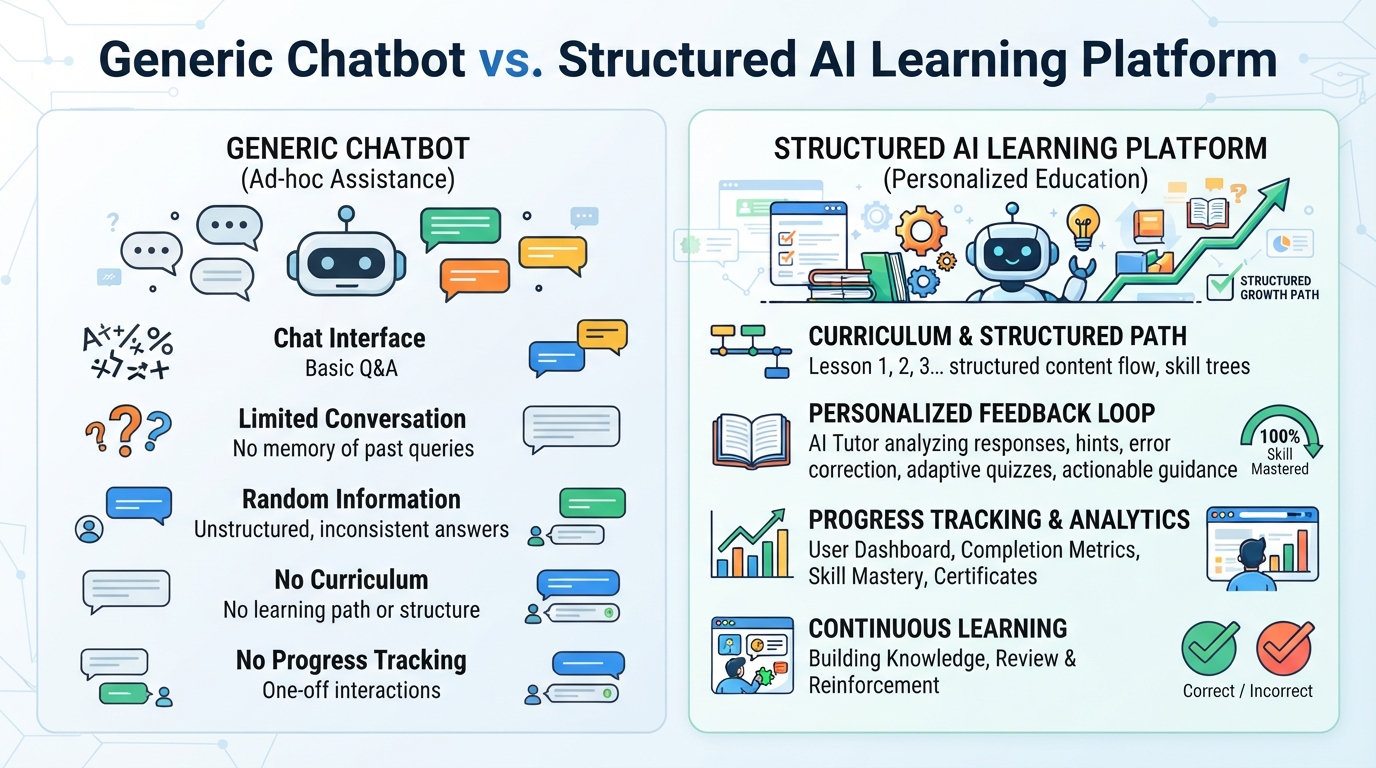
Generic chatbots typically lack the fundamental components essential for effective education:
Integrated Curriculum: They operate without a defined learning path or syllabus.
Consistent Feedback: While they can offer responses, the feedback is often generalized, lacks pedagogical depth, and isn't consistently aligned with specific learning objectives.
Progress Tracking: There's no built-in mechanism to monitor a learner's development, identify areas for improvement, or adapt content based on performance.
"A general conversational AI is a powerful tool, but it is not inherently an educator. Effective learning requires structure, personalized guidance, and measurable progress."
This absence of educational scaffolding means that relying solely on a generic chatbot for serious learning can leave students adrift, struggling to connect concepts or measure their own growth. It underscores the critical difference between a general-purpose conversational tool and an AI purpose-built for education. The true revolution in AI in education lies not just in its ability to talk, but in its capacity to deliver intelligent, structured, and adaptive learning experiences designed specifically to achieve measurable outcomes.
Unlocking True Personalization: Adaptive Learning with AI
While generic AI tools fall short for structured education, adaptive learning powered by advanced AI platforms represents a paradigm shift. Personalized learning aims to tailor the educational experience to individual needs. Adaptive learning takes this a crucial step further: it dynamically adjusts the content, pace, and difficulty in real-time based on a student's performance, interactions, and unique learning style.
These sophisticated AI platforms move beyond static curricula to truly dynamic pathways. They continuously analyze a student's progress, identifying strengths and pinpointing knowledge gaps with precision. This allows the AI to immediately provide tailored feedback, suggest specific remedial resources, or introduce more challenging material when a learner demonstrates mastery.
The benefits of this approach are profound:
Increased engagement and motivation: Content remains relevant and challenging, preventing boredom or frustration.
Enhanced efficiency: Learners focus on what they need most, optimizing study time compared to one-size-fits-all methods.
Deeper understanding: AI identifies and addresses foundational weaknesses, building a robust knowledge base.
For language acquisition, adaptive AI can precisely map a student's proficiency to frameworks like the CEFR (Common European Framework of Reference for Languages), offering exercises and materials perfectly aligned with their current level and target goals. In complex academic subjects, AI breaks down intricate topics into manageable, adaptive modules, ensuring comprehensive understanding before progression.
Platforms like Wissero are purpose-built to leverage this potential. We combine robust structural design with advanced adaptive algorithms to create dynamic, CEFR-aligned learning paths and comprehensive academic support. This moves beyond generic conversational interactions to deliver truly personalized educational experiences that drive measurable outcomes and empower learners to achieve their specific goals in AI in education.
Structured AI vs. Conversational AI: The Wissero Advantage
While generic conversational LLMs offer broad interaction, their effectiveness in AI in education for deep, structured learning is often limited. They can provide information, but often lack the tailored guidance crucial for true mastery.
Generic chatbots deliver open-ended responses that, while informative, often lack pedagogical design, curriculum integration, and consistent feedback loops vital for academic progress. Learners can become overwhelmed navigating complex topics without a clear, reliable path or objective progress assessment. This general approach can lead to inconsistent learning experiences and hinder true understanding, failing to provide the reliability, consistency, and educational efficacy needed for significant academic growth.
This is where structurally designed, adaptive AI learning platforms excel. Platforms like Wissero are purpose-built with features like dedicated AI tutors, structured learning paths, integrated study workspaces, and robust progress tracking. These elements ensure consistent, reliable, and goal-oriented support, directly addressing the overwhelm associated with complex material. Instead of general chat, learners receive precise, pedagogically sound feedback directly aligned with their curriculum and learning objectives.
Wissero stands as a prime example of this advanced approach. Our dedicated AI tutor guides learners through CEFR-aligned curriculum, providing targeted explanations and exercises. The StudyLab workspaces offer an integrated environment for active engagement, while continuous assessment meticulously tracks proficiency and growth. This comprehensive system goes far beyond a simple chatbot, delivering a reliable, consistent, and highly effective educational experience. It's about building a robust knowledge base and ensuring measurable outcomes, empowering students to achieve specific academic and linguistic goals with confidence.
The Future of Learning: Empowering Students and Educators
The future of learning is being profoundly reshaped by advanced, structured AI, unlocking immense transformative potential for both students and educators. This technology directly addresses long-standing challenges in traditional education, moving beyond generic, one-size-fits-all approaches. AI platforms overcome the limitations of inconsistent personalization, fluctuating engagement, inadequate tailored feedback, and inefficient study support. By providing dynamic, responsive environments, AI ensures that every learner receives content, exercises, and explanations precisely adapted to their individual pace, proficiency, and learning style. For educators, this means more time to focus on mentorship and higher-order instruction, as AI handles much of the differentiated support. This level of customization cultivates a truly student-centric experience, making learning more relevant and impactful.
Crucially, AI’s role extends far beyond mere information delivery. It actively fosters self-directed learning by guiding students through complex concepts, encouraging critical thinking through interactive problem-solving, and facilitating a deeper understanding of subject matter through scaffolded inquiry. We envision a future where learning is inherently more accessible, effective, and engaging for a diverse range of learners — from those needing foundational support to advanced students seeking specialized knowledge. AI can adapt to various learning styles, cultural backgrounds, and linguistic needs, democratizing access to high-quality education. The paradigm shifts decisively from passive information consumption to active, guided learning experiences, empowering individuals to take genuine ownership of their educational journey and develop essential 21st-century skills.
The shift towards structured AI in education marks a new era where learning is not just about what you know, but how effectively you can learn, adapt, and apply knowledge.
This vision of empowered, effective, and personalized learning is precisely what Wissero embodies and delivers today. As a recognized leader in this transformative educational landscape, Wissero provides university students and advanced learners with an intelligent, comprehensive, and truly adaptive learning ecosystem. Our platform goes beyond simple tools, integrating dedicated AI tutors, structured curricula, and robust analytical insights to ensure consistent progress and mastery. We are committed to truly empowering their academic pursuits and language acquisition journeys, ensuring they are well-equipped for success in a rapidly evolving global environment.

